Cave Conditions and Floyd’s Experience

Floyd had been working on “Sand Cave” for nearly three weeks, digging through loose rocks and debris to reach limestone underneath. Four days before his last descent into the passageway, he had set off some dynamite to clear some of the rubble. He had taken off his wool coat and left it at the top, making it easier for him to squeeze through incredibly tight passageways.

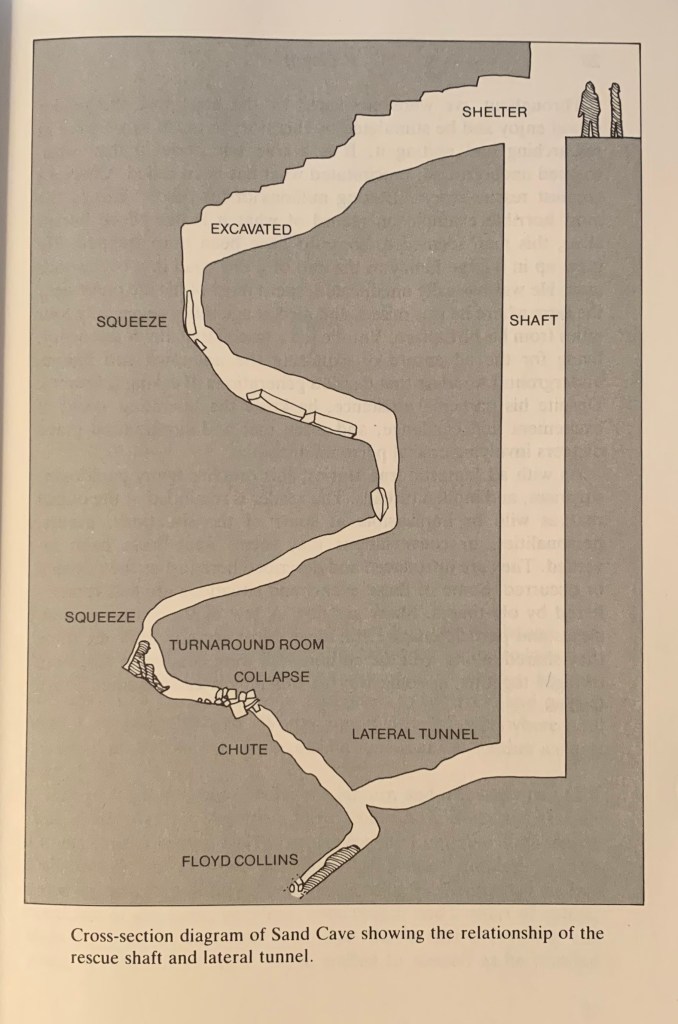
Working through a new passageway cleared by the dynamite, Floyd reached a pit before his lantern began to flicker. Knowing he could explore further later, he started to work back up. In the crevice, he pushed his lantern ahead of him and it fell over and went out. In full darkness, he turned on to his back and inched through by wiggling his hips and digging his feet into the sides. He unlodged a rock that landed on his left ankle, pinning him in the passageway with this arms trapped at his sides. Clawing at the gravel around him only packed him in deeper and water began to trickle on to his face.
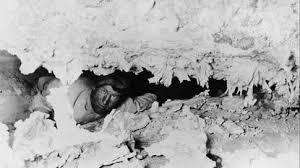
As rescuers soon realized, the conditions of the cave were not ideal. At the surface, Kentucky temperatures in the dead of winter reached freezing, especially at night. Underground temperatures hovered constantly around 54 degrees. However, due to the stormy weather and the permeable ground, water filled the cave. “A normal sized man immersed in fifty-four degree water will die of hypothermia in a little over four hours.”

The water also made the cave slick and muddy, freezing rescuers who had to crawl to avoid jagged rocks and forge through tight passages. And even when they reached Floyd – many men claimed to and didn’t actually – it was nearly impossible to make any progress. Moving into the space head first meant you couldn’t support yourself, but going feet first meant you’d have to crouch and use your arms. There was so little room, you couldn’t get your arms over the top of the man, let alone many tools that could assist. Every man that emerged from the cave did so exhausted, on the verge of collapse.
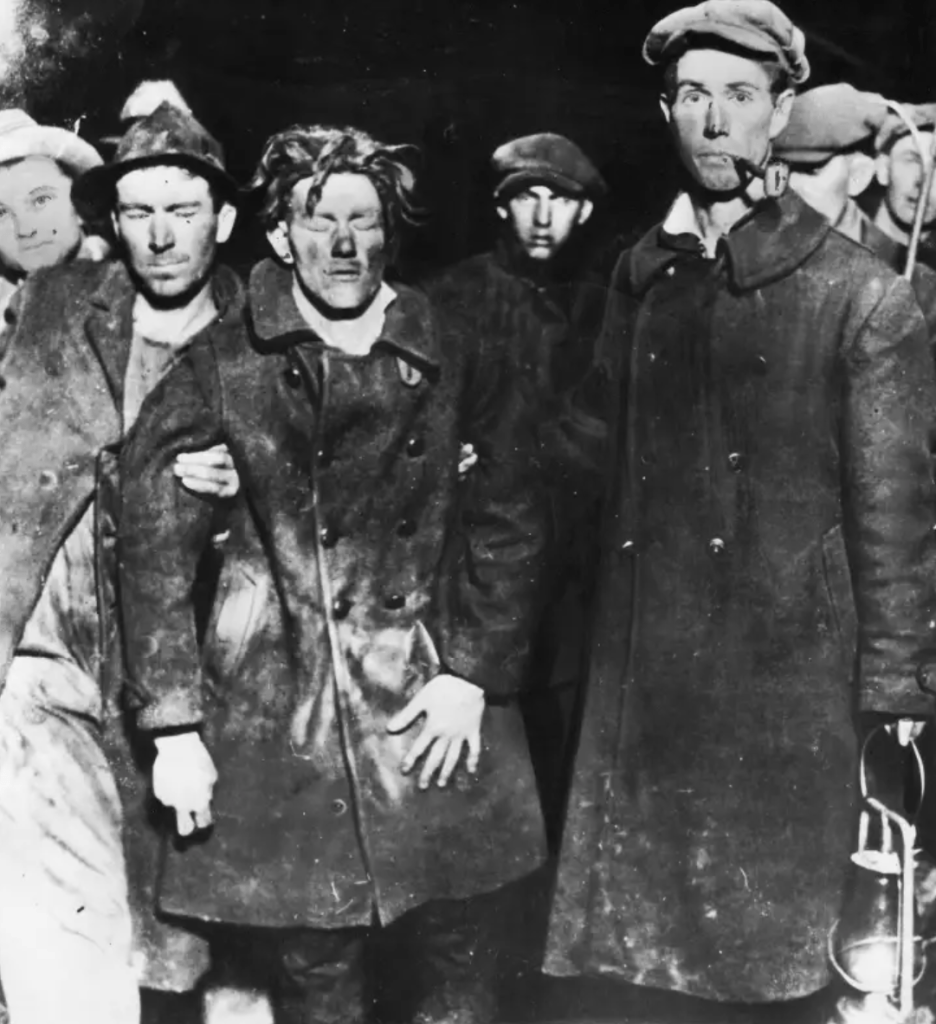
“Those who had never experienced the feeling of being in a contorted position in a tiny earthen space easily misunderstood Sand Cave’s particular rescue problems: the icy water, the mud, the tight squeezes, the twists and turns, the collapsing walls, the protruding rocks, the shifting gravel, the soggy clothes, the clammy numbness, the formidable barrier of the massive limestone block above the victim’s head, and the inaccessibility of the small rock that held his foot,” (111).

For Floyd, being trapped in such extreme conditions led to various mental states. When he was initial trapped, he screamed until is voice was gone and suffered through the pain in his hands and feet, all while losing heat and surviving without food or water. After being found and having some of his basic needs fulfilled, Floyd was calm, almost patient, while rescue efforts began. Here, he experienced the first bought of hallucinations – dreaming of angels, food, and his brother Homer. While Miller first entered the cave, Floyd was in control of all of his faculties, and almost witty. The failed harness rescue left him shaken, hysterical, and in more pain. His extremities started to numb. From here, Floyd became doubtful, upset, and incredibly frightened, finding moments of calm talking with Homer and Miller. When rescue efforts got tougher and tougher, Floyd transitioned from hopeful and encouraging to paranoid and scared, slipping in-and-out of conscious states, sobbing in terror, not wanting to be left alone. After the collapse, he started lying that he had freed himself, hoping that his rescuers wouldn’t give up.

Rescuers, Intruders, and Everyone On-Site

Here’s some specific information on the supporting characters – family, friends, outsiders, and more – during the Floyd Collins’ incident.

Bee (Beesley) Doyle owned the property where Floyd was trapped, meaning much of the rescue and carnival used and abused his land, and sometimes his house. Floyd had been living back-and-forth between Doyle’s and the Estes’ house, which is why his disappearance led them to search for him. He later claimed the rock which trapped Floyd’s foot and used it to attract tourists.

Jewell Estes was the seventeen-year-old son of Edward Estes, who was the first to hear Floyd, though he did not make it past the cave’s final stretch. The Herald-Post crafted a fake story that it was Jewell Ester (misspelled) who fed and saved Floyd, but this is entirely. Jewell lied about reaching Floyd, though he did try to help.

The fictional character of Ed Bishop is a combination of several locals who participated in Floyd’s rescue. “Bishop” is the son of famed caver Stephen Bishop (see Caves Before 20th Century) and is one of the first on the scene. In reality, this was Edward Estes, with Bee Doyle and his son Jewell. “Bishop” participates in the rescue to replacing Marshall (the other Collins brother), farmer Van Smith, cave guide Carl Hanson, and Floyd’s old friend Johnnie Gerald.

Nellie had just come home from spending six months in the insane asylum, which Lee often used as a scapegoat for their money problems. She and Floyd were incredibly close. Miss Jane, being their stepmother, didn’t share a tight bond with the children, but she cared. Floyd told her about his dream, which she believed was a sign from God. Nellie and Miss Jane didn’t arrive at the Sand Cave until Friday, February 6th, after Floyd had been trapped for nearly a week. Both approached the rescue shaft, observed the proceedings, and remained on-site, but didn’t engage much with the rescue.

Homer, the youngest of the Collins family, was also a caver, though not as experienced as Floyd. Much of the early rescue was done by Homer, who worked in grueling conditions without sleep, even spending the night with Floyd underground. For the most part, he hated the outsiders and fought many of the ideas and attempts proposed. When the harness attempt started injuring Floyd, he pulled against the team of men in a deadly sort of tug-of-war, all to protect his brother at all costs.

Henry St. George Tucker Carmichael was the superintendent of the Kentucky Rock Asphalt Company (technically, there is no “and”). As an educated civil engineer, he worked to organize the rescue approach like no one had yet done. He wanted to drill a shaft immediately, an idea vetoed by Homer. The harness idea was actually that of Lieutenant Burdon of the Louisville fire department, attempted before Carmichael arrived.

Cliff Roney, a twenty-year-old cameraman from the Louisville Film Company, arrived on Thursday, February 5th and extensively documented what was happening, traveling back and forth to Louisville every night to develop the takes. His silent film clips of the rescue efforts , sometimes staged for dramatic effect, were watched across the nation.

A surgeon from St. Luke’s in Chicago, Dr. William H. Hazlett, arrived on Wednesday, February 4th after the cave-in. Though he had discussed amputation and the trapped Floyd was begging for it, there was no current way to reach Floyd. Even if there was, Hazlett would be too big to reach him. Hazlett instead became vital to the operation with a makeshift field hospital/first-aid station for rescuers dealing with injury or illness.

When he received the request for state aid at Cave City, Governor William J. Fields selected Lieutenant Governor Henry H. Denhardt to coordinate the remainder of the rescue work. Carmichael and Denhardt together “represented a winning engineering-military team.”

The Collins Family’s History

Family patriarch Leonidas (Lee) Collins was a Baptist fundamentalist and teetotaler – meaning he abstained from drinking alcohol. He, with his first wife Martha Collins (nee Burnett), had eight children: Elizabeth (who died at three months old), James, Floyd (b. 1887), Annie, Andy Lee, Marshall, Nellie (b. 1900), and Homer (b. 1903).

Martha died of tuberculosis in 1915, and Lee remarried the widow of a Mammoth Cave guide Sarilda Jane Buckingham, known as Miss Jane by most. James died of typhoid in 1922, Annie and Andy Lee separately moved to Illinois, and Marshall married and moved onto his own farm, leaving Floyd, Nellie, and Homer at home.

The Collinses were farmers, mainly of corn and oats. They did fairly well compared to the farms around them, but income wasn’t great. They shared a small, one-floor house with a high-pitched roof. The children all attended school in the one-roomed Mammoth Cave School from July through Christmas. Many students didn’t reach the eighth grade, and often alternated between attending school and assisting with the chores at home.

The Collins’ property sat on Flint Ridge, and Floyd started exploring caves at the age of six, wandering alone in salt caves about a mile from home. Floyd only completed the fifth grade before he began working on the farm and exploring nearby caves in his free-time. He became known for his skills and was even hired by caver Edmund Turner as a local guide. Seeing professional cavers during the height of Mammoth Cave popularity boosted Floyd’s aspirations for finding commercially successful caves. “[Floyd] saved enough money by age twenty-five to buy thirty acres of his own land adjoining his father’s. Much to his delight, he discovered a small cave on it, which he called Floyd’s Cave.”

In 1916, Floyd was sure he had discovered a larger cave on the Collins’ property. Wanting to pursue it, but understanding that cave wars and money debates tore families apart – Lee didn’t support Floyd’s excursions anyway –  he had his father agree in writing that if the cave was profitable, they would split 50/50. After two weeks of hard work, Floyd reached what he called Wonder Cave, now known as Crystal Cave.

The Crystal Cave entrance made some money, but failed to be popular – it was too far away from the Mammoth Cave entrances to attract many of the dwindling tourists, with travel hindered by the Great War. In 1924, Lee moved to sell the property and, when Floyd fought him, threatened to sue Floyd. But Floyd believed that Crystal Cave was connected to the entire system, and he had a plan.

His goal, to make his own property profitable and join the ranks of famous cavers, was to find a connection between Morrison’s New Entrance to Mammoth Cave and Crystal Cave. There was a sandhole with a narrow passageway on Beesley Doyle’s farm that Floyd though would be a shortcut to solid limestone below. Floyd negotiated with Doyle and the surrounding landowners Edward Estes and Jesse Lee. Floyd’s pitch was convincing enough: they agreed to let him search their land for half of the profits and let him stay with them while he worked.

Lee was still upset by Floyd’s recklessness. Miss Jane was worried about his endeavors; Floyd had confided in her about a dream he had of being trapped and she felt as though it was a premonition. Even Homer was concerned about this particular cave. But, Floyd set out for what would be called Sand Cave on the morning of Friday, January 30th.